 Ever-Power Group


Pre-processing requirements for gear tooth profile before carburizing and quenching
Publication time: 2020-06-22 Website: https://ptogearboxes.com Edit: EP
Most of the carburized and hardened gears are finally processed by grinding teeth to eliminate the heat treatment deformation of carburizing and hardening, and become high precisionHardened gear, Before carburizing and quenching, the tooth profile is pre-processed with a pre-grinding hob, and the required grinding allowance, tooth undercut and other parameters in the grinding gear are guaranteed to meet the requirements of gear grinding technology and gear manufacturing.Therefore, the tooth profile of the gear before grinding must meet the following requirements:
XNUMX. The grinding allowance of the gear should be even:
due togearDeformation will occur after carburizing and quenching, which will reduce the accuracy. These deformations must be corrected in the subsequent grinding of the teeth. Therefore, the amount of gear remaining should be determined by the maximum deformation of carburizing and quenching.
Generally speaking, the maximum deformation is mainly related to the heat treatment performance of the material, the technological level of heat treatment, the structure of the gear and the geometric size, etc. Therefore, the above factors should be considered comprehensively for the remaining wear allowance.
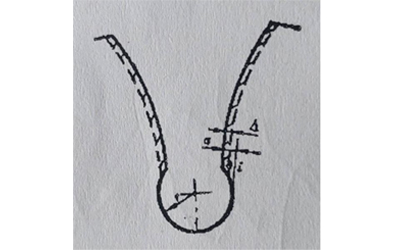
XNUMX. The gear should have a certain amount of undercutting at the root of the tooth for three reasons:
1. An empty knife is needed for the root of the tooth in grinding
2. In terms of increasing the bending strength of the gear, there must be a certain amount of undercut at the root of the gear.Because the residual stress at the root of the tooth after carburizing and quenching is compressive stress, which is very beneficial to improve the bending strength of the gear.
If the tooth root does not have a certain amount of undercutting, further processing of the tooth root surface will cause the compressive stress to become tensile stress. According to relevant data, this will reduce the bending fatigue strength of the gear by about 17% to 20%.
3. In terms of anti-breaking ability, there must be a certain amount of undercutting at the root of the tooth, and there is no certain amount of undercutting at the root of the tooth. It is inevitable for finishing to produce steps at the root of the tooth, which will cause greater stress concentration. , Which seriously affects the ability to resist broken teeth.
XNUMX. The involute length of the gear after grinding should be long enough:
Due to the undercutting of the tooth roots, the involute length of the gear may not be enough after grinding, resulting in a reduction in the coincidence of the gears, resulting in serious vibration and noise during the meshing process, and also reducing the load and uniform load capacity of the gear. .
Therefore, the gear after grinding should have an involute of sufficient length to ensure the smooth transmission of the gear and the realization of uniform load in the load.
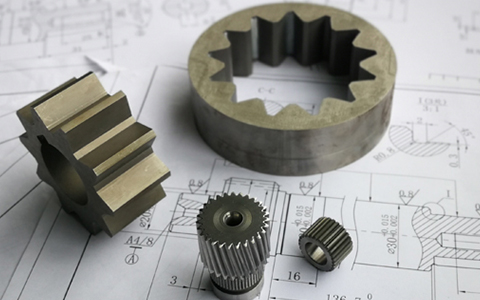
In summary, the requirements for pre-processing of gear tooth profile before grinding are as shown in the figure below.
![Oil pump gear [customized]](ptogearboxes/xiaoE/upload/file/img/2020/10/5f9a8130d4e57.jpg)
![Encoder gear [customized]](ptogearboxes/xiaoE/upload/file/img/2020/10/5f9a7c8ae4b27.jpg)