 Ever-Power Group


New gear technology
Publication time: 2020-11-27 Website: https://ptogearboxes.com Edit: EP
At present, the most widely used involute cylindrical gear has gradually formed a complete set of mature processing methods and equipment due to its advantages in design, processing, testing and assembly, and has long occupied a dominant position.However, due to its inherent convex-convex contact mode, the comprehensive radius of curvature of the tooth profile is strictly limited by the center distance, which affects the improvement of the contact strength of the tooth surface and the formation of a dynamic pressure oil film. The unevenness of the sliding coefficient of the tooth surface is large, which leads to the gear tooth. The wear and life is reduced.In order to compensate for the lack of strength of involute gears, scholars have successively proposed various types of cylindrical gear transmission forms, such as circular arc gears, parabolic gears, circular arc toothed cylindrical gears, micro-segment gears, staggered cylindrical gears, etc. Etc. [1].
New gear technology
Cylindrical gear transmission using the convex-concave meshing method mainly includes arc gear transmission, parabolic gear transmission, and arc tooth line cylindrical gear transmission.Among them, the first two use the convex-concave meshing between the tooth profiles, while the latter uses the convex-concave meshing in the tooth direction. The effects of the two are different.In addition, there are new convex-concave meshing gear transmissions such as micro-segment gears and point-line meshing gears, which are still in the preliminary research stage.
(1) Parabolic gear
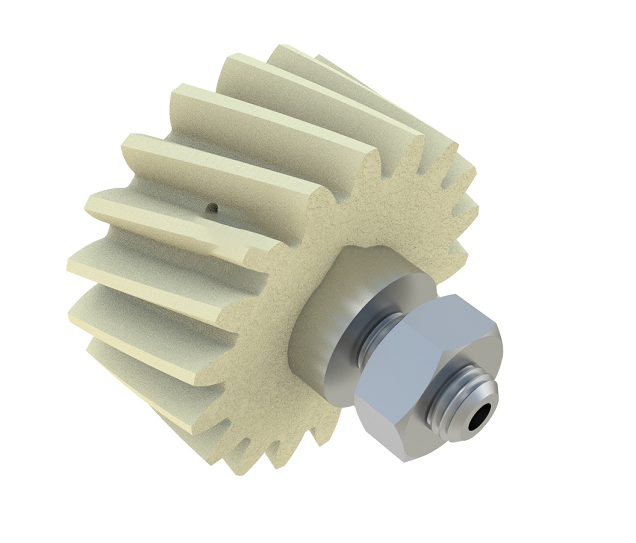
As early as the early 80s, Professor Wen Zhifu proposed the concept of line contact parabolic gear (see Figure 1) and applied for a Chinese patent (CN86100544) [2]. The purpose of his invention was to greatly improve the cylindrical gear. Carrying capacity.
Figure 1 Parabolic gear and tooth profile
In the monograph published later [3], three basic tooth profiles of parabolic gears were proposed, which were named PWX-I, PWX-II, and PWX-III.The PWX-I type is similar to the double circular arc gear, with convex teeth outside the pitch line of the gear, and concave teeth inside the pitch line. A pair of parabolic gears can be processed with a hob; while PWX-II and PWX-III They are the basic tooth shapes of the hobs for cutting small gears and large gears with only one meshing area, similar to the two hobs used to process small gears and large gears in a single circular arc gear pair.In terms of processing, the method of hobbing parabolic gears with a hob is studied, and the hobbing machine with the same involute gear is used, and the design and manufacturing measurement methods of the hob are introduced.
In terms of application, in 1981, a modulated parabolic gear with a modulus of 3 was used to replace the carburized, hardened and ground involute gear of a 40 marine gearbox, which was used on the inland tug of the Shazhou Shipping Company. damage. In 6, modulated and nitrided parabolic gears were used in MB1983 marine gearboxes, hardness HRC170-50, modulus 55, transmission power 3 horsepower, single-stage transmission ratio 105, carburized hardened gear involute with the same model Gearbox butt joint, as a test speed-increasing box for involute gearbox, under full speed and full load conditions, after 5.06 hours endurance test, unpacking inspection, tooth surface contact is good, there is no pitting, and the noise is normal.The test shows that the nitrided parabolic gear after hobbing has the same strength as the carburized, quenched, ground involute gear with the same technical parameters and high load-bearing capacity.Later, it was shipped and used by Jiangsu Wuxian Shipping Company and Sand Shipping Company, and the application effect was good.
In addition, the boiler speed control box designed with parabolic gears is half the weight of the original ZKL boiler speed control box with involute gears.In the direct-acting open mill, the parabolic gear is used as the transmission box, and the obvious effect of eliminating the two pairs of involute gears has also been achieved. The parabolic gear is used for the transmission of the flexible tube pump, and only one stage is used. The parabolic gear achieves a transmission ratio of 11.33, which satisfies the transmission requirements. Compared with the involute gear, the manufacturing cost of the former is only half of the latter.It is used for ordinary gear reducers, and its carrying capacity (power) can reach 220%~270% of similar involute gear reducers [3].
Literature [3] detailed the basic characteristics of parabolic gears, design calculation methods, manufacturing technology, precision inspection, etc., and from the tooth profile slip rate, machining interference, relative principal curvature, tooth root limit working point thickness and transmission "Partiality" and many other aspects are compared with involute gears, and the advantages of parabolic gears are analyzed.However, some of the design calculation methods, especially the strength calculation and meshing characteristic analysis, are relatively simple. For example, the calculation of contact stress and bending stress adopts the Hertz formula and the Luis-Hyssman formula, so the error is relatively small. Large; only theoretically simply analyzes the properties of the meshing line and the contact line, without considering the impact of installation and manufacturing errors on the meshing characteristics and strength; due to the lack of computer technology at that time, there is no impact on the meshing rigidity, transmission error, and modification. Analysis and research are carried out on the aspect; in addition, the method of grinding teeth is not discussed.The meshing form of the line contact makes the parabolic gear still more sensitive to installation errors.All of this makes the ability of the parabolic gear not shown.
Although it has been seen from many test results and trial practices in some companies that the parabolic gear has achieved a good effect of significantly improving the carrying capacity, but with the development of single circular arc gears and double circular arc gears in the same period and their standardization , The demand for cylindrical gears with high load capacity in general industry has been met by arc gears.Therefore, parabolic gears have not been taken seriously for many years.With the development of new gear analysis and design technology, the transmission performance of parabolic gears can continue to be explored.In addition, the emergence of modern CNC gear grinding machines provides the possibility for the grinding of high-precision hard-tooth surface parabolic gears, so parabolic gears have great application potential.
Litvin proposed a new type of point-contact parabolic gear in the literature [4, 5]. The gear transmission integrates convex-concave meshing form, point contact and other characteristics, with low stress, low error sensitivity and ability to grind teeth.The matched gear adopts different parabolic parameters, and the preset parabolic transmission error is obtained by crowning the tooth to reduce vibration and noise.In this paper, the principle of generative processing of such parabolic gears is given, and the finite element analysis is used to compare the strength performance of such gears with modified involute helical gears. It shows that the contact of this kind of gear ratio with the same parameter Both the strength and the bending strength must be high.As shown in Figure 1, the meshing tooth profile can adopt a large radius of curvature to obtain a relatively large radius of curvature, which significantly reduces the contact stress.By using a large difference in the radius of curvature between the tooth profiles (as shown in Figure 1, the two tooth profiles at the contact point O at the center of curvature are c1 and c2 respectively, and the distance between the two can be adjusted design), the contact can be reduced The impression is sensitive to the center distance error, so the noise of the transmission is small.The point-meshing parabolic gear has the problem of stress concentration caused by the use of large curvature difference, which has been compensated by the large radius of curvature of the tooth profile.At the same time, because the tooth profile is simple (closer to involute gears), it is convenient to use shaped grinding teeth, and carburizing and quenching technology can be used to improve the hardness of the tooth surface, so it is suitable for high-speed and heavy-duty transmission, and it is very promising to replace aviation high-speed Involute gear in transmission.
(2) Arc gear
The idea of arc gear was first proposed by American engineer Wild Harper in 1926 [1,6,7]. Afterwards, Novikov of the former Soviet Union completed the discussion on the principle of meshing and calculation of strength, and began to discuss It is applied in industry.Therefore, it was named Wildhaber-Novikov Gear, or WN Gear for short.After decades of research, my country has made great achievements in the basic theory and manufacturing technology of arc gears.The basic meshing theory of point meshing circular arc gear (normal arc) with Chinese characteristics is established; the calculation method of load-bearing capacity is established.Theoretical analysis and calculation of thermal elastohydrodynamic lubrication; the principle and calculation of tooth end modification; the calculation of accuracy inspection and measurement size; the design and calculation of hob tooth profile and a series of basic theories and technological methods have enabled the research on my country's arc gear transmission technology Walk in the forefront of the world.A number of national standards have been formulated for the tooth profile, cutting tools, strength calculations of single arc gears and double arc gears.It is widely used in low-speed and heavy-duty industries such as metallurgy, mining, petrochemical, and transportation, and it is also used in high-speed gear transmissions such as steam turbines and compressors.
There are few research reports on arc gears abroad, mainly in the literature of Professor Litvin [8].Literature [8] studied the tooth profile, geometry, meshing and contact of the arc gear, determined the contact path on the tooth surface and the main contact direction of the instantaneous contact ellipse, and studied the transmission error caused by the installation error; "Partial synthesis" technology.There are a lot of discussions on arc gears in China [6-9], mainly about tooth profile parameter design, stress analysis, load distribution, running-in performance and wear, hobbing, scraping, honing and other processing technologies and methods. These studies are Improving the bearing capacity of arc gears has played a great role in promoting the development of standardization and being widely used.In terms of gear grinding technology, the literature [9] pointed out that the processing method of using a shaped grinding wheel to grind arc gears is not yet mature, and there are no other related reports.Arc gears have very strict requirements on root circle deviation, and the efficiency is too low when the gear grinding machine is used for radial feed, so the added value (value) of the product is too low and the economic benefit is not high.The general industry tends not to grind gears to reduce costs and improve market economic benefits.The current national standard arc gear has the highest precision grade of grade 5. The technology used is medium-hard tooth surface modulation treatment, and the surface is nitrided after gear hobbing; the machining accuracy of carburized and quenched arc gears can only reach grade 6. These processes It cannot meet the requirements of aviation cylindrical gear transmission with a pitch line speed above 160m/s.
In order to improve the reliability and maintainability of the helicopter main reducer, and at the same time improve the contact strength and bending strength of the gear teeth, as well as the anti-glue ability, the aviation industry has made a plan to apply the arc gear transmission to the helicopter main reducer. Related research [10], but no reports of related research results, mainly because the arc gear is too sensitive to tooth profile errors and installation errors.In recent years, new transmission types such as three-arc gears and four-arc gears have emerged. These studies have made valuable efforts to continue to develop the load-bearing potential of arc gears.
(3) Circular arc tooth line cylindrical gear
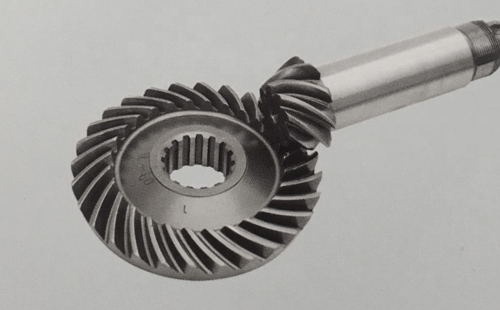
The arc tooth line cylindrical gear is a new type of cylindrical gear with curved teeth (as shown in Figure 2), which has the advantages of high bending strength, no axial force, and smooth transmission.Since 1965, some scholars at home and abroad have conducted theoretical research and technological exploration on circular arc tooth line cylindrical gears [11-13].
Figure 2 Circular arc tooth line cylindrical gear
In theory, it mainly studies the geometric equations of tool tooth surface, contact line, conjugate tooth surface and end surface section, meshing surface, meshing line and so on.Obtain geometric characteristics such as the undercut limit curve, meshing limit curve, and induced curvature.And research on gear tooth contact analysis, machining simulation and so on.The machining of circular arc tooth line cylindrical gears mostly uses the tooth-by-tooth machining method of Gleason milling cutter. On this basis, Ma Zhenqun et al. [13] studied the tooth surface mismatch machining method.In recent years, it has been studied to use ordinary hobs to continuously cut gears on CNC gear hobbing machines, which has significantly improved processing efficiency and reduced costs.Part of our country has also successfully trial-produced this type of gear and applied it to coal mine machinery, steelmaking equipment and other products, and achieved certain economic benefits.
The designer hopes to use it to replace involute helical gears or herringbone gears in the future, but this kind of gear still has some problems, mainly: the design of arc tooth line cylindrical gear is more complicated; the tooth width design has limitations, and it also affects The increase of coincidence degree; the use of circular broaching method makes the gear tooth width small and the degree of bending is low; and the use of gear hobbing machining requires 6-axis linkage CNC machining machine tools, so it is not easy to popularize.
in conclusion
In summary, gear design will develop towards advanced technology, active design methods, and improved reliability with the goal of reducing meshing impact and noise and improving transmission performance; and towards improving contact line load, tooth surface stress, and tooth root stress. Distribution and the development of the modification design to achieve the minimum dynamic load angle.Internationally, power transmission devices are developing in the direction of miniaturization, high speed, low noise, and high reliability.The research and development of tooth profile design must comprehensively consider these characteristics and tap the inherent potential of special tooth profile gears in order to meet the fundamental needs of modern high-speed and heavy-duty gear transmissions.
<Previous article:EP Transmission | We sincerely invite you to visit Shenzhen Industrial Exhibition
>Next: No more
![Oil pump gear [customized]](ptogearboxes/xiaoE/upload/file/img/2020/10/5f9a8130d4e57.jpg)
![Encoder gear [customized]](ptogearboxes/xiaoE/upload/file/img/2020/10/5f9a7c8ae4b27.jpg)