 Ever-Power Group


Gear processing丨The transmission principle of processing helical cylindrical gears
Publication time: 2019-12-04 Website: https://ptogearboxes.com Edit: EP
Gear processingHelical cylindrical gearThe transmission principle is explained as follows, for reference and understanding, if you are unclear or related requirements, you can consult EP free of charge.
Transmission principle of machining helical cylindrical gears:
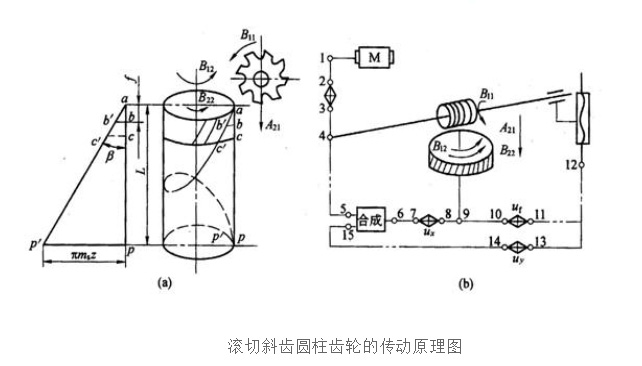
Figure b is the transmission principle diagram of the hobbing helical cylindrical gear, in which the generating motion transmission chain, the vertical feed motion transmission chain, the main motion transmission chain andTransmission principle of spur gear相同,只是在刀架与工件之间增加了一条附加运动传动链:刀架(滚刀移动A21)-12-13-uy-14-15-合成机构-6-7-uX-8-9-工作台(工件附加转动B22),以保证螺旋齿形线。
This transmission chain is also called a differential motion transmission chain, in which the displacement mechanism uy adapts to the change of the workpiece helix lead L and the direction of the helix.
Picture a can illustrate this problem visually: suppose the helix of the workpiece is right-handed, when the hob feeds f (in mm) along the axial direction of the workpiece, and the hob moves from point a to point b, then the workpiece is in addition to generating motion In addition to B12, it is necessary to rotate bb' to form a spiral tooth line.
In the same way, when the hob moves to point c, the workpiece should rotate cc' additionally.
By analogy, when the hob moves to point p (a workpiece spiral lead L), the workpiece rotates pp', which is exactly one additional revolution.
Whether the rotation direction of the additional movement B22 is the same as the rotation direction of the workpiece generating movement B12 depends on the spiral direction of the workpiece and the feed direction of the hob.
As shown in Figure B12 and B22 in the same direction, add 1 revolution to calculate the additional movement, and vice versa.
When hobbing helical cylindrical gears, it is necessary to ensure that the two rotational motions of B12 and B22 are transmitted to the workpiece at the same time without interference. It is necessary to configure a motion synthesis mechanism in the transmission system to combine these two motions and then transfer them to the workpiece. .
The actual rotational movement of the workpiece is synthesized by the generated movement B12 and the additional movement B22 that forms a spiral.
Note: Compared with spur gears, helical cylindrical gears have involute tooth profiles, but the tooth length direction is not a straight line, but a helical line.
Therefore, processing helical cylindrical gears also requires two forming motions: one is the generative motion to form the involute tooth profile; the other is the motion to form the long helix of the tooth.
The former is the same as machining spur gears. The latter requires that when the hob moves along the axial direction of the workpiece, the workpiece will generate an additional rotation on the basis of the generative motion B12 to form a helical tooth profile trajectory.
Follow-up EP editor will continue to update othersGear processingRelated content, stay tuned!
![Oil pump gear [customized]](ptogearboxes/xiaoE/upload/file/img/2020/10/5f9a8130d4e57.jpg)
![Encoder gear [customized]](ptogearboxes/xiaoE/upload/file/img/2020/10/5f9a7c8ae4b27.jpg)