 Ever-Power Group


The development history of gears at home and abroad (for reference)
Publication time: 2019-11-28 Website: https://ptogearboxes.com Edit: EP
The following development history of gears at home and abroad is for reference only. If you have any unclear points or related product requirements, you can consult EP Precision Gear Custom for free.
XNUMX. Ancient foreign gears:
According to historical records and physical evidence that has been passed down to the present, Egypt and Babylon began to use gears as early as 400-200 BC.
1. The Greek philosopher Aristotle (384-322 BC) mentioned gears in his book "Mechanical Problems", which is the earliest documentary record of gears abroad.
2. The Greek scholar Archimedes (287-212 BC) specifically recorded a worm drive winch.
3. In the 1st century BC, the Roman architect Vitruvius described a hydraulic pulverizer equipped with a gear drive. This is a specific record of the earliest power transmission gear.
4. Around 150 BC, Ctesibius of Alexandria used gear mechanisms for hydraulic timers, and Heron made taxis and sights. This is about using gear mechanisms for The earliest record of transmission movement.
5. Of course, all the above gears are handmade by carpenters.
6. In the Middle Ages, gears and mechanical clocks were combined.
7. In 1484, Waltherns of Germany used mechanical clocks for astronomical observations.During this period, with the use of water power, wind power, and animal power, considerable gears for power transmission appeared.
8. In the latter part of the 15th century, da Vinci recorded various gear devices in his manuscripts.
9. The research on tooth profile theory began in the late 17th century.
10. In the 18th century, with the arrival of the industrial revolution pioneered by the invention of the steam engine, gear technology developed rapidly.
XNUMX. Ancient Chinese gears:
According to a large number of unearthed cultural relics and historical records, it is proved that my country is one of the earliest countries to use gears.
1、1956年在河北武安午汲古城遗址中,发现了直径约80mm的铁齿轮,经研究确为战国末期到西汉(公元前3世纪至公元24年)间的制品。
2、1954年在山西永济县蘖家崖出土的器物中,有直径为25mm、40齿的青铜棘齿轮,经研究确定为秦代至西汉初年(公元前221年~公元24年)遗物。
3、1957年陕西长安县红庆村出土了一对直径为24mm、齿数都为24的青铜人字齿轮,据分析系东汉初年(公元1世纪)遗物。
4. The muddy image of water transport made by Zhang Heng of the Eastern Han Dynasty (AD 78-139) was driven by water leakage, and through a gear system, the muddy image revolved around the axis at a constant speed every day.
5. The Jili drum car that appeared in the Three Kingdoms period has a set of reduction gear system.
6. The guide car made by Ma Jun (AD 235), in addition to gear transmission, also has a clutch device, indicating that the gear system has developed to a considerable extent.
7. The earliest record of gear transmission in historical books is the description of the armillary sphere made by Liang Lingzhan in the 13th year of Kaiyuan Tang (AD 725) in the "New Tang Book·Astronomical History".
8. The "New Yixiang Fa Yao" records in detail the water transport rigging platform manufactured by Su Song, Han Gonglian and others in the 3rd year of Yuanyou in the Northern Song Dynasty (1088 AD). The platform is huge in scale and already has a set of relatively complicated gear transmissions. system.
9. In the Ming Dynasty Mao Yuanyi's "Wu Bei Zhi" (1621 AD) has recorded the gear and rack transmission.
XNUMX. History of cycloid gears:
1. The gears before the 17th century operated at unequal speeds.
2. In 1674, the Danish astronomer Roemer O proposed the use of epicycloid tooth profile to make gears move at a constant speed.
3. In 1694, French scholar Haier gave a lecture on "Cycloid Wheel" at the Paris Academy of Sciences, and put forward the view that "the gear of the epicycloid tooth shape meshes with the point gear or the pin wheel at constant angular velocity."
4. In 1733, French mathematician Camy studied the tooth profile of clock gears and put forward the famous "Basic Theory Theorem of Meshing" or "Camus Theorem".
5. In 1832, British Reid thought: "When a gear with a given number of teeth meshes with a gear with a different number of teeth, its tooth profile should be different", and the issue of interchangeability was raised for the first time.
In the middle of the 6th century, British Willis proposed that the outer and inner sides of the pitch circle adopt a compound cycloid tooth profile with an outer cycloid and an inner cycloid respectively. The rolling circle of the cycloid has nothing to do with the number of teeth. This tooth profile can be correct regardless of the number of teeth. Meshing is interchangeable gears.
7. Soon, Brown Sharp sold a profile milling cutter designed based on this tooth profile.
8. Today, although involute gears account for the overwhelming majority, the cycloid is still used as the tooth profile curve of the gears and Roots wheels in the cycloid pinwheel planetary reducer, while the gears in the clock are still composite Cycloid tooth shape.
XNUMX. History of involute gears:
1. The use of involute as the gear tooth profile curve was first proposed by the French scholar Hire P.D.L in a lecture on "cycloid theory" in 1694.
2. In 1765, the Swiss scholar Euler independently conducted an analytical study on the tooth profile without knowing the research results of Haier and Camus. Appropriate, so Euler is the true pioneer of involute tooth profile.
3. Sarary has further improved this theoretical analysis method and has become the Euler-Savary equation widely used in the study of tooth profile.
4. In the mid-19th century, British Willis (Willis. R) pointed out that when the center distance changes,Involute gearWith the advantage of constant angular speed ratio, the superiority of involute gears has gradually been recognized by people.At the same time, he selected a standard gear with a pressure angle of 14.5°, and took the tooth height as 1/D·P, thus laying the foundation for the inch (diameter control) gear system.
5. In 1894, German Reuleaux (F) wrote in his English translation:
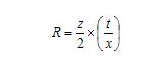
(R is the radius of the indexing circle, z is the number of teeth, and t is the pitch) formula. Later, the French used the term modulus. In 1927, modulus was officially listed as the DIN standard, laying the foundation for the metric (modulus system) involute gear了基。 The foundation.
6. In the first half of the 19th century, Fan Chengfa gear cutting machine tools appeared. In 1835, Whitworth.J was granted a patent for gear hobbing machines.
7. In 1900, Pfauter.H added a differential device and created the first universal hobbing machine capable of rolling helical gears.Since then, the use of Fancheng method to process gears has taken an overwhelming advantage, and involute gears have spread all over the world.
8. In 1873, Hoppe in Germany first proposed the concept of involute displacement gear.
9. In 1899, Lasche (Lasche. O) first implemented the variable gear scheme.
10. In 1908, Maag (Maag.M) developed the "Maag Gear".Later, scholars from various countries proposed a series of calculation formulas for displacement coefficients, calculation charts appeared, and various displacement and modification schemes for the involute tooth profile.
XNUMX. History of arc cylindrical gears:
1. In 1907, the British Frank Humphris (Humphris.F) first published the arc tooth profile, whose pinion was a pin wheel.
2. In 1912, Smith (Smith) published an arc profile gear.
3. The BB gear originally researched by Bostock and Bramley, was trial-produced by Vickers in 1922 and called the VBB gear. Its pinion gear is a convex tooth profile with a large tooth profile. The gear is a concave tooth profile with a convex and concave tooth surface meshing. Because the thickness of the concave tooth tip is small, it is easy to break, which limits the application.
4. In 1916, Matsumura Tsuruzo of Japan published an envelope tooth profile with convex and concave contact.Grant.G.B proposed the concept of axial meshing transmission. It is recommended to take the addendum height of the helical gear close to zero, and make a pair of teeth contact only on the pitch circle, completely relying on the axial coincidence. Ensure the continuity of transmission.
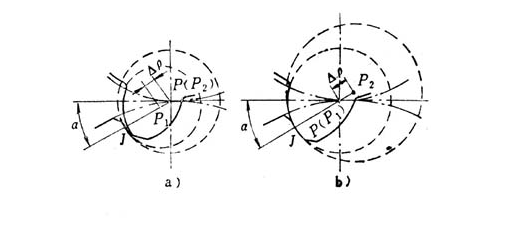
5. In 1926, the American Wildhaber (Wildhaber. E. W) proposed a circular arc cylindrical gear scheme based on the above concept. The center of the arc radius P of the concave gear tooth profile is on the rack-type tool pitch line. , The center P of the concave tooth profile coincides with the node P, the arc radius P of the convex tooth profile is smaller than P by a value of p, and the center P is located on the radius line JP of the nominal pressure angle (Figure 1-3a).This gear has not been manufactured.
6. In 1934, Lysholm (Lysholm), Sweden, manufactured cylindrical gears with circular arcs in the SRM company.
7. In 1956, the Soviet Union Novikov (Novikov. ML) proposed and completed the arc cylindrical gear. The center P of the convex tooth profile is on the pitch line of the rack-type tool, and the arc radius of the concave tooth profile It is larger than the arc radius of the convex tooth profile by p, and its center P is on the extension line of the radius of the nominal pressure angle (Figure 1-3b).The contact of the gear teeth is to move along the longitudinal direction of the tooth surface, and the contact movement speed and pressure angle remain unchanged.
8. At the International Gear Conference held in Essen, Germany in 1960, the arc gear with point meshing was called "W-N gear" to indicate that this kind of gear was first proposed by Wildhaber and developed by Novikov.
9. In the spring of 1959, Professor Zhu Jingzi brought the point meshing arc gear materials back to China from the Soviet Union, and carried out propaganda and promotion.In the same year, "Mechanical Translation Series" introduced it again.
In the 10s and 60s, both the Soviet Union and China began to develop "double circular arc gears" with both convex and concave teeth on one tooth.
11. In 1970, Stnder.RM's stepped double circular arc gear obtained a US patent.
12. China has made good achievements in the research of double-arc tooth profile, and has formulated a unified tooth profile.
XNUMX. Tooth shape development history:
So far, the development of gear tooth profile has generally gone through five stages:
1. The first stage is the gear stage.For the gears seen in the original gears used in ancient times, the tooth profile and pitch are not considered.
2. The second stage is the equal pitch gear stage. Before the 18th century, although there was no theoretically correct tooth profile, it was possible to take the tooth pitch into consideration and make a gear that can correctly transmit rotational motion based on experience.
3. The third stage is the use of cycloid gears.In order to make the gears move at a constant speed, the tooth profile theory has been studied since the 17th century. In 1674, Danish Romer proposed the use of epicycloid teeth. In 1733, Cami of France proposed the basic law of gear meshing. In the mid-19th century, British Willis proposed a compound cycloid tooth profile.Soon, forming milling cutters designed based on this tooth profile were sold on the market, making cycloid gears popular all over the world.
4. The fourth stage is the involute tooth profile stage.Using involute as the tooth profile, although it was proposed by Haier of France as early as the end of the 16th century, Eular-Savary conducted an analytical study on the involute tooth profile.British Willis pointed out that when the center distance changes, the angular speed ratio of the involute gear does not change, and the superiority of the involute gear is gradually recognized by people.However, it was not until 1900 that Profort first created a universal gear hobbing machine, and the use of Fan Cheng method to cut gears took the overwhelming advantage, and involute gears gradually dominated the world.
5. The fifth stage is the development stage where multiple tooth shapes coexist.Throughout the 20th century, involute gears dominated. In the 50s, arc gears with point meshing (W-N gears) appeared, which are mainly suitable for high-speed and heavy-duty occasions.In addition to the continued use of cycloidal gears in clocks and watches, new progress has been made in the cycloidal pinwheel planetary reducer.According to the requirements of industrial development, Archimedes spiral gears, parabolic gears, hypoid gears, elliptical gears, integrated curve gears, unnamed curve gears, etc. have appeared, and the involute gears themselves are constantly improving. (Such as displacement, edge trimming, shape trimming, etc.).In order to adapt to various requirements, all these tooth shapes are constantly being improved, and new tooth shapes are constantly being produced.Various tooth shapes coexist and penetrate each other. One day, a new type of tooth shape that can adapt to various requirements and absorb the advantages of various tooth shapes may appear.
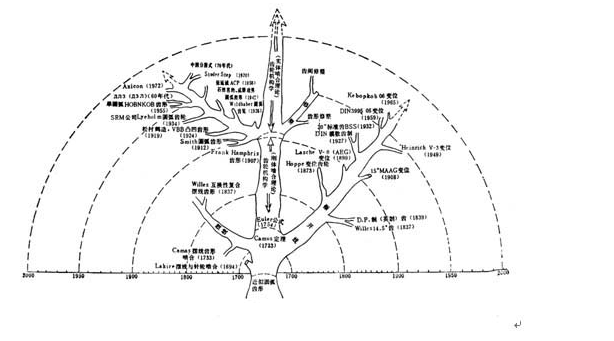
XNUMX. Gear tooth profile development tree:
A diagram showing the development of gear tooth profile technology in a tree-like form.The picture is more vivid, it clearly shows the development sequence and age of various tooth shapes, and reflects the mutual relationship between the tooth shapes.
XNUMX. The history of gear strength calculation:
1. In 1937, Bukingham divided the tooth surface wear into six failure modes: pitting, abrasive wear, gluing, spalling, abrasion and seizure.
2. In 1939, Rideout divided gear damage into 8 failure forms: normal wear, pitting, spalling, gluing, scratches, cuts, rolling and hammering.
3. AGMA1951 in 110.02, Borsoff and Sorem in 1953 proposed the types of gear damage.
4. In 1968, the Austrian National Standard stipulated the terminology of gear damage.
5. In 1967, Niemann.G, based on a large number of tests, drew the limiting relationship of load capacity for the four failure modes of involute gears.
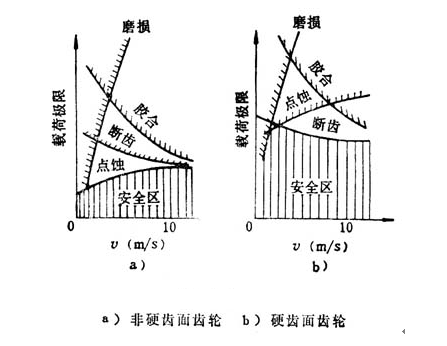
When the circumferential speed is not too high, the main factor that limits the load-bearing capacity of involute non-hardened gears is pitting, and hardened gears are broken teeth; for high-speed gears, the main factor is often gluing.In general, wear is not the main factor limiting the load-bearing capacity.
6. In 1785, Watt regarded the gear teeth as a cantilever beam with a rectangular section and calculated the bending strength of the gear teeth.
7. In 1893, Lewis (W) first proposed the concept of "tooth profile coefficient" and used the inscribed parabola method to find the dangerous section of the gear. The Lewis formula laid the theoretical foundation for the calculation of the bending strength of gear teeth.
8. According to the results of Keck's photoelastic test in 1950, Maier suggested using the "30° tangent method" to approximate the weakest cross-section of the 20° involute tooth profile. This method has been used by many The calculation formula was adopted. From 1976 to 1978, China's Zhengzhou Institute of Machinery used the photoelastic method to discover the "double peak phenomenon" of double circular arc gears, and proposed that the Lewis formula is only applicable to involute gears and the 30° tangent method is only applicable to pressure For involute gears with an angle of 20°, the stress distribution of involute gears also has a bimodal phenomenon.
9. In 1881, Hertz proposed a formula for load distribution on the contact surface when two cylinders were in contact, which was used as the theoretical basis for calculation of tooth surface strength.
10. In 1908, Videky applied Hertz's theory of contact stress between two cylinders to gears.
11. In 1940, the American AGMA proposed that the tooth surface strength calculation uses the maximum contact stress at the heaviest load point.
12. In 1949, Buckingham adopted the calculation method that the contact stress of the tooth surface on the pitch circle did not exceed the allowable value. This method was adopted by many subsequent calculation methods.
13. In 1966, Ishihashi Akira published a method for selecting the hardness of the gear tooth surface and bending strength.
14. In 1980, ISO put forward the "Basic Principles of Involute Cylindrical Gear Bearing Capacity", and published the calculation method of gear tooth bending strength and tooth surface contact strength.
15. In 1983, my country formulated the "Calculation Method for Carrying Capacity of Involute Cylindrical Gears" (GB348083) with reference to the ISO method.The standard divides gear damage into five categories: wear, tooth surface fatigue, plastic deformation, tooth fracture, and other damage.The content includes two check calculation methods of tooth surface contact strength (pitting resistance) and gear bending strength (anti-broken tooth).
In 1935, General Motors of the United States conducted a large number of investigations on the gluing of automobile gears.Almen proposed using pressure-velocity (PV) to determine the gluing limit of gears.
In 1950, it was proposed to use the PVT value as an index to calculate the gluing. In the formula, T is the length of the meshing line from the engagement to the engagement (in).
In 1954, Winter deduced the F value proportional to PVT. In 1955, he and Niemann jointly studied and modified it.
In 1962, Dudley proposed the "gluing benchmark number" (gluing index) based on the instantaneous temperature rise calculation formula.
In 1963, Bolsov drew the relationship between gluing load and speed based on an experimental report.
In 1975, the gluing calculation method proposed by the International Association for Standardization/Technical Committee 60/Working Group 6 (ISO/TC60/WG6) adopted the Blok instantaneous temperature specification and the overall (integrated) temperature specification.Currently, gluing calculations are only performed in specific industries.
The strength calculation of gears was initially limited to bending strength and tooth surface wear. With the increase of load and speed, the tooth surface strength-pitting resistance and anti-glue calculations were proposed.
At present, countries continue to use modern scientific and technological achievements to improve traditional gear calculation methods, such as the use of optimized design, reliability design and value analysis; the use of computer-aided design; the fracture mechanics method in material strength, and the finite element method in structural strength , Friction and wear and lubrication theory, etc., make the calculation method of gear strength more perfect and gradually conform to actual working conditions.
XNUMX. Calculation history of tooth surface contact strength:
1. The calculation of tooth surface contact strength is mainly based on the formula of load distribution on the contact surface proposed by Hertz in 1881 as the theoretical basis for the calculation of tooth surface strength when two cylinders are in contact.
2. In 1899, Germany Lasche (Lasche.O) first studied the tooth surface strength and put forward the "specific surface pressure", thus unifying the concept of tooth surface contact stress.
3. In 1908, Austrian Widecki applied the contact stress theory of Hertz's two cylinders to calculate the tooth surface stress of gear teeth, and drew the maximum contact stress variation diagram along the meshing line.
4. In 1932, British BSS-436 proposed the calculation of tooth surface strength based on experimental data, using "foundation surface stress".
5. In 1940, the tooth surface strength calculation of the American AGMA 211.01 adopted the maximum value of the contact stress at the heaviest load point.
6. In 1949, Buckingham proposed a calculation method for the contact stress of the tooth surface on the pitch circle not to exceed the allowable value. Later, this method was adopted by many calculation methods.
7. In 1954, Niemann used the rolling pressure at the maximum load point, and Dudley used the maximum Hertzian stress on the pitch circle.
8. In 1966, Ishihashi Akira proposed a method of selecting the hardness of the gear tooth surface and bending strength.
1920年江达赛克(Jandasek),1921年兰彻斯特(Lanchester);1926年铁木辛柯(Timoshenko)和班德(Band);1928年肖特(Short),1932年欧利气(Vlrich);1935年阿尔门(Almen)、韦(Way);1937年西原、小林;1939年梅尔达(Meldahl);1943年尼曼、格洛别兹(Glanbitz)等对齿面点蚀现象的机理进行了研究。
In addition, Beeching and Nicholls in 1948, Globez in 1950, Henriot in 1972, etc., on the cause of pitting, the location of the initial crack, and the depth of the pit Research has been carried out, but so far, the research on the cause of pitting corrosion is not mature enough.
XNUMX. Calculation history of gear tooth bending strength:
1. As early as 1785, Watt regarded the gear teeth as a cantilever beam with a rectangular section and calculated the bending strength of the gear teeth.In his work, Sehess-Thoss listed 18 formulas for calculating the bending strength of gears in the 19th and 15th centuries in Britain and the United States. All these formulas are derived from the cantilever beams with rectangular cross-sections. of.
2. In 1893, Louis published the formula for calculating the bending strength of gear teeth, citing the "tooth profile coefficient" for the first time.The external load p acts on the tooth top point a (Figure l-2a), intersects the tooth symmetry line along the ab line at point b, considering only the bending stress caused by the horizontal component force Pu, and draws the inscribed parabola and tooth profile from point b Cut at two points c and d, the cd line is the dangerous section of the gear tooth. The Lewis formula laid the theoretical foundation for the calculation of the bending strength of gear teeth.
3. According to the result of Keck using the photoelastic method to determine the weakest cross-section of the tooth in 1950, Mel suggests using the "30° tangent method" to approximate the weakest cross-section of the involute tooth profile when α=20°.
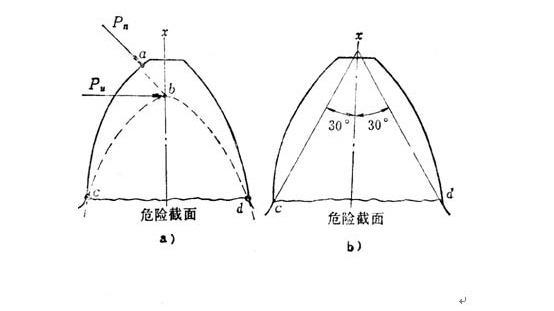
This method was confirmed by Niemann and Glaubit.
4、1928年白金汉著《正齿轮》(Spurgears)一书,1942年梅里特(Merritt.H.E)著《齿轮》(Gears)一书,1949年白金汉又著《齿轮的机构学分析》(Analytical Mechanics of Gears)一书,1952年白辛格(Bnsinger)、1954年达德利、尼曼、1957年石川,以及1940~1959年AGMA、1940年BSS、1963年DIN、1963年MAAG、1967年JSME等都发表了有关轮齿弯曲强度计算公式或方法。对危险截面有的提出抛物线法,有的提出30°切线法、基准齿条的齿顶线法等。
5. From 1976 to 1978, the Zhengzhou Machinery Research Institute of my country discovered the "double peak phenomenon" of the bending stress distribution in the photoelastic bending stress analysis of double circular arc gears, and proposed that the Lewis method is only applicable to involute gears, 30 °The tangent method is only applicable to involute gears with a pressure angle of 20°, and the "double peak phenomenon" of stress distribution also exists in involute gears.
6、1977年ISO制订了弯曲强度计算方法,1984年我国参照ISO方法亦制订了弯曲强度计算方法(GB3480—83),均采用30°切线法。
XNUMX. Gear technology development tree:
A diagram showing the development of gear technology in a tree-like form.It vividly shows the development process of gear technology branches and backbone, the relationship between various fields and the development trend of gear technology.
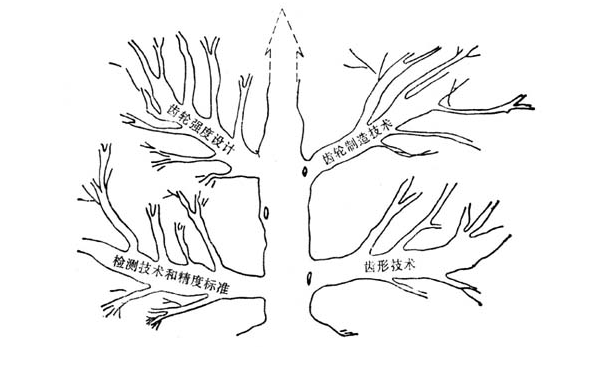
The above is the relevant content about the development history of gears at home and abroad, including but not limited to, for reference only. For more questions or related product requirements, please contact EP Precision gear machining Free consultation.
<Previous article:Comparative description of gear shaper gears and precision forged gears
>Next:Gear parameter diagram
![Oil pump gear [customized]](ptogearboxes/xiaoE/upload/file/img/2020/10/5f9a8130d4e57.jpg)
![Encoder gear [customized]](ptogearboxes/xiaoE/upload/file/img/2020/10/5f9a7c8ae4b27.jpg)