 Ever-Power Group


Difficulties in gear processing (for reference)
Publication time: 2020-04-29 Website: https://ptogearboxes.com Edit: EP
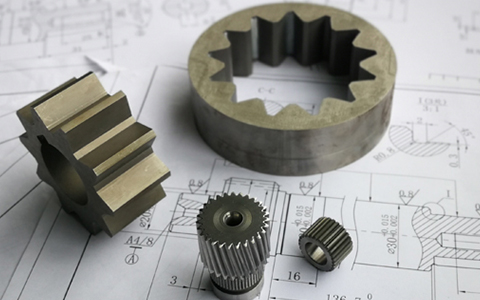
The difficulties of gear processing mainly exist in the following aspects, for reference and understanding.
XNUMX. Process design of gears
1. Precision design of gear blank
due togearThe transmission accuracy of the gear is mainly determined by the accuracy of the tooth profile and the uniformity of the tooth pitch distribution. This stage is mainly to prepare a fine reference for the next stage of the tooth profile, so that the accuracy of the inner hole and end face of the tooth basically meets the specified technical requirements.
2. Design of gear tooth profile
At this stage, gears that fully meet the requirements of the drawing should be manufactured, and the tooth profile accuracy required by the final precision of the tooth profile must be produced in this stage.
3. Heat treatment process of gear
In this stage, the main hardening treatment is performed on the tooth surface to make the tooth surface reach the required hardness.
4. Seiko of tooth shape
It is to correct the tooth shape deformation caused by the gear after quenching, further improve the tooth shape accuracy and reduce the surface roughness, so that it can meet the final accuracy requirements.
Second, the determination of positioning datum
The accuracy of the positioning reference has a direct impact on the accuracy of the tooth profile.
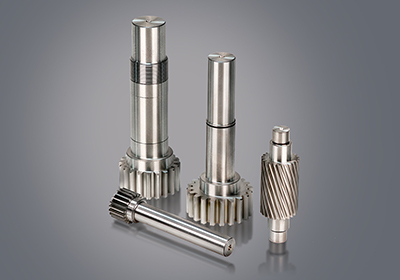
Gear shaftThe tooth profile generally chooses the top hole positioning.
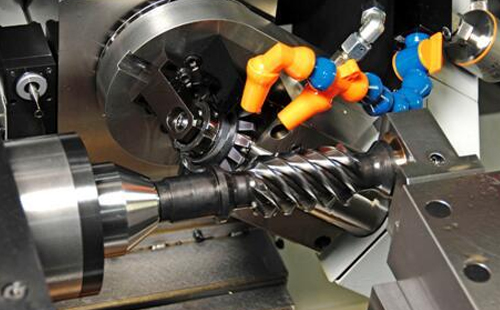
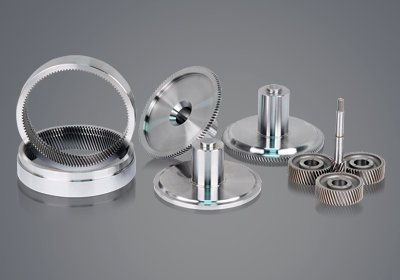
The tooth profile of disc gears often uses two positioning references.
For some large-modulus shaft gears, the gear journal and one end face are positioned.
1. Inner hole and end face positioning
Choosing the inner hole, which is not only the design reference but also the measurement and assembly reference, as the positioning reference, not only conforms to the principle of "reference coincidence", but also makes the process reference such as tooth profile uniform.
2. Positioning of outer circle and end face
The inner hole of the tooth blank is installed on the universal mandrel, and the center position of the hole is determined by aligning the outer circle. Therefore, the radial runout of the outer circle of the tooth blank to the inner hole is required to be small.
XNUMX. Gear end precision design
1. The tooth end of the gear is processed with rounding, chamfering, chamfering, and deburring.
Gears that are rounded and inverted are easy to engage when sliding in the axial direction.
Chamfering can remove the sharp edges of the tooth ends. These sharp edges are very brittle after carburizing and quenching, and are easy to crack in the gear transmission.
2. When the tooth end is rounded with a milling cutter, the milling cutter swings back and forth along an arc while rotating at a high speed.
After one tooth, the workpiece is withdrawn in the radial direction, and then sent to the next tooth end after completion.
3. The tooth end must be arranged before the gear is quenched, usually after the gear hobbing.
Fourth, fine benchmark correction
1. The reference hole is deformed after the gear is quenched. In order to ensure the precision quality of the tooth profile, the reference hole must be corrected.
2. For gears with spline holes centered on the outer diameter, it is usually corrected with a spline push tool.Avoid skewing when pushing holes.
3. For the correction of cylindrical gears, hole pushing or hole grinding can be used, with high hole pushing rate, which is often used for unhardened gears;
4. The precision of hole grinding is high. For gears with large inner hole deformation and high hardness after overall quenching, or products with larger inner holes and thinner thickness, hole grinding is appropriate.
5. The gear index circle is generally used for centering when grinding holes, so that the radial runout of the ring gear after grinding can be smaller, which is beneficial for later grinding or honing.
The above description of the difficulties of gear processing, including but not limited to, welcome to add if there are any deficiencies.
![Oil pump gear [customized]](ptogearboxes/xiaoE/upload/file/img/2020/10/5f9a8130d4e57.jpg)
![Encoder gear [customized]](ptogearboxes/xiaoE/upload/file/img/2020/10/5f9a7c8ae4b27.jpg)